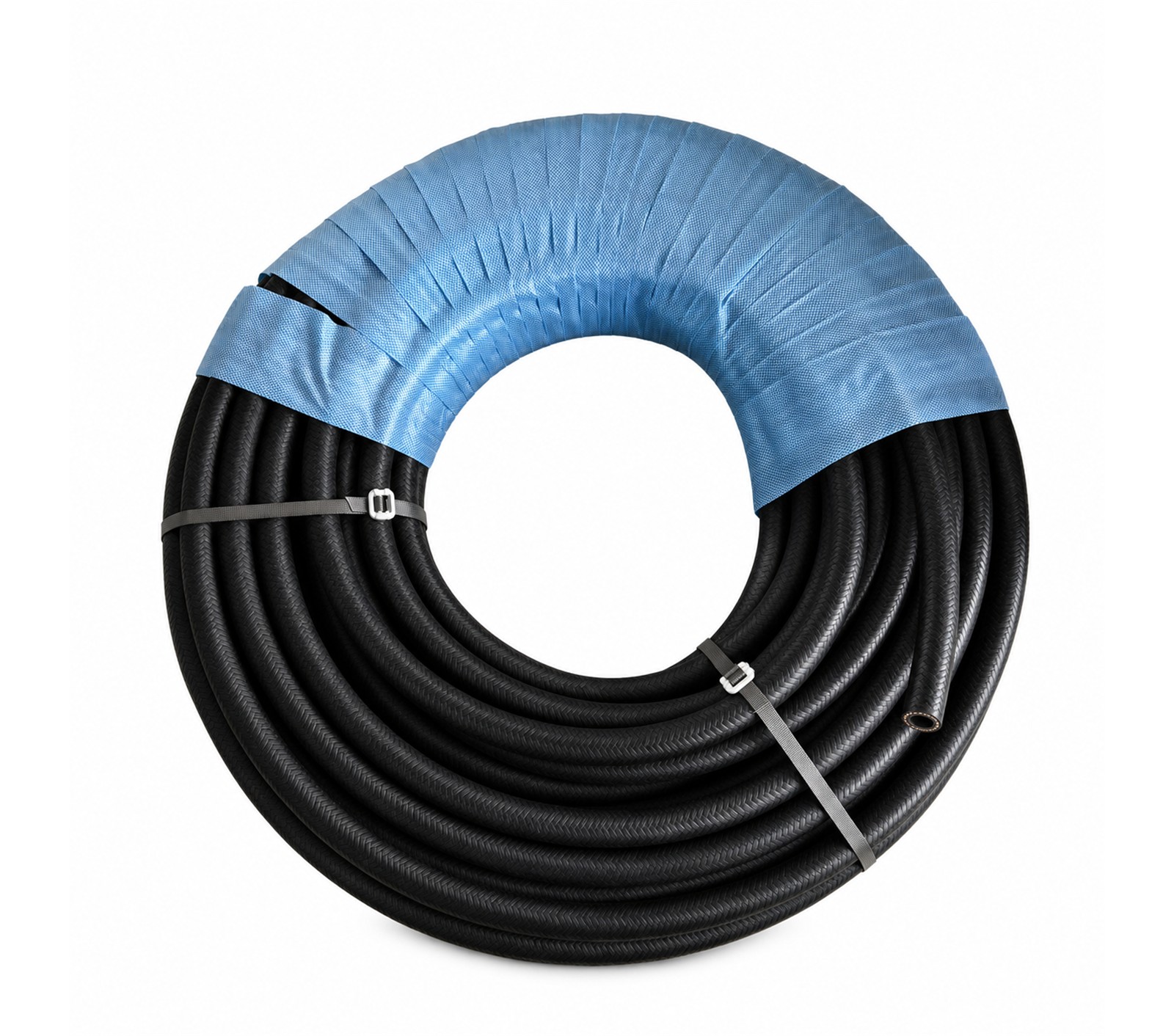


Sewer flushing hose supplies high-pressure water to cleaning equipment for drains, sewer lines and culverts. Its reference construction uses a smooth black SBR tube, textile-braid reinforcement and a smooth NR/BR cover for repeated movement through the cleaning route.
Sewer flushing hose supplies high-pressure water to cleaning equipment for drains, sewer lines and culverts. Its reference construction uses a smooth black SBR tube, textile-braid reinforcement and a smooth NR/BR cover for repeated movement through the cleaning route.
The smooth outer surface is intended to help movement and cleaning, but routing, abrasion and nozzle loads still need to be assessed for the installed system. Select the hose and end connections for the jetting equipment rather than bore alone.
| ID (inch) | ID (mm) | OD (mm) | WP (MPa) | WP (psi) | BP (MPa) | BP (psi) | Bend radius (mm) | Weight (kg/m) |
| 1/2 | 13 | 25 | 25 | 3625 | 62.5 | 9062.5 | 180 | 0.59 |
| 3/4 | 19 | 31 | 25 | 3625 | 62.5 | 9062.5 | 240 | 0.89 |
| 1 | 25 | 39 | 25 | 3625 | 62.5 | 9062.5 | 300 | 1.37 |
Reference temperature: −35°C to +80°C. The three source entries list 25 MPa working pressure and 62.5 MPa burst pressure. Pressure conversions are retained as published. Bend radius and mass are size-specific; do not apply the smallest size values to the larger bores.
Confirm the required finished length, reel compatibility, coupling design and complete assembly rating. Burst pressure is not a permitted operating setpoint, and a reference schedule does not establish that an individual assembly has already passed a pressure test.
Supply the pump pressure, flow, water temperature and nozzle connection. Confirm the hose bore and length against the machine recommendation and the pressure loss through the complete assembly. Describe whether the duty involves municipal drains, culverts or industrial sewer lines.
Check the selected size against the hose reel, guides and minimum bend radius. Inspect the smooth cover for cuts and local wear caused by sharp drain edges. Route the assembly to reduce snagging, twisting and contact with moving parts.
Provide the working and transient pressures, end fitting drawings, finished assembly length and inspection requirements. Confirm cleaning-fluid compatibility if chemicals are added to the water. Agree on replacement criteria for the actual duty rather than assuming a general abrasion-resistant description guarantees unlimited service life.
Specify material, ID and OD, working pressure, temperature, length, connections and quantity.



Send the conveyed material, pressure, temperature, required bore, installed length and fitting specification. Compare each related construction using its own dimensional and pressure schedule.


