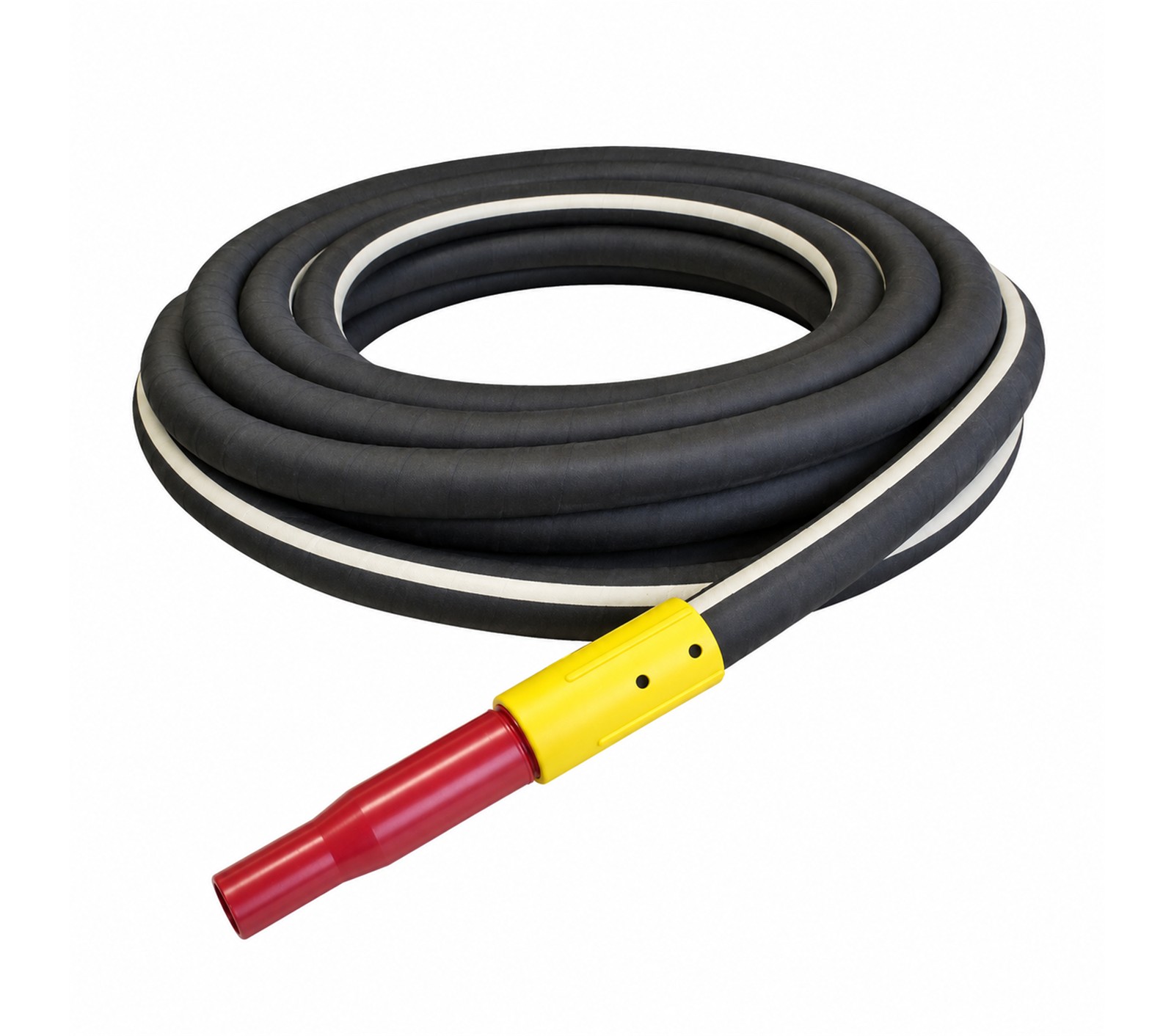


Sandblast hose is a softwall construction for conveying compatible abrasive media in blast-cleaning equipment. The reference uses a smooth black natural-rubber tube, multiple synthetic-fabric reinforcement plies and a natural-rubber outer cover. The 12 bar schedule includes two outside-diameter options for the 1-inch bore.
Sandblast hose is a softwall construction for conveying compatible abrasive media in blast-cleaning equipment. The reference uses a smooth black natural-rubber tube, multiple synthetic-fabric reinforcement plies and a natural-rubber outer cover. The 12 bar schedule includes two outside-diameter options for the 1-inch bore.
Specify the abrasive type, particle size, operating pressure and nozzle/coupling system. Confirm the required static-dissipative performance and assembly test; an abrasion-resistant material description does not establish electrical continuity or guaranteed service life.
| ID (inch) | ID (mm) | OD (mm) | WP (bar) | WP (psi) | BP (bar) | BP (psi) | Length (m) | Length (ft) |
| 1/2 | 12.7 | 25 | 12 | 180 | 36 | 540 | 60 | 200 |
| 5/8 | 15.9 | 30 | 12 | 180 | 36 | 540 | 60 | 200 |
| 3/4 | 19.1 | 34 | 12 | 180 | 36 | 540 | 60 | 200 |
| 1 | 25.4 | 39 | 12 | 180 | 36 | 540 | 60 | 200 |
| 1 | 25.4 | 47 | 12 | 180 | 36 | 540 | 60 | 200 |
| 1-1/4 | 32 | 48 | 12 | 180 | 36 | 540 | 60 | 200 |
| 1-1/2 | 38 | 54 | 12 | 180 | 36 | 540 | 60 | 200 |
| 2 | 51 | 69 | 12 | 180 | 36 | 540 | 60 | 200 |
| 2-1/2 | 64 | 84 | 12 | 180 | 36 | 540 | 60 | 200 |
| 3 | 76 | 96 | 12 | 180 | 36 | 540 | 60 | 200 |
| 4 | 102 | 124 | 12 | 180 | 36 | 540 | 60 | 200 |
| 5 | 127 | 149 | 12 | 180 | 36 | 540 | 30 | 100 |
| 6 | 152 | 177 | 12 | 180 | 36 | 540 | 30 | 100 |
Reference temperature: −40°C to +70°C (−40°F to +158°F). Working pressure is listed as 12 bar / 180 psi and burst pressure as 36 bar / 540 psi. The source image swaps the inch and mm labels over its first two columns; the headings above follow the actual values, without changing the numbers.
The 1-inch / 25.4 mm bore has separate 39 mm and 47 mm OD entries. Specify both dimensions. The source mentions abrasion loss at or below 60 mm³ using DIN 53516; this is a source reference, not an independently verified test result for a supplied hose. Obtain applicable abrasion and continuity documents if required. Nominal pressure and length pairs remain as published.
Identify the abrasive, particle distribution, air supply and maximum operating pressure. Select bore and length against the blasting equipment requirements and expected pressure loss. Sand, steel shot and other media can produce different wear conditions.
Provide coupling and nozzle-holder drawings, including the hose ID and OD they accept. Keep the two 1-inch OD versions separate when selecting fittings. Describe routing, dragging conditions and any required protective sleeve or restraints.
Specify the required electrical continuity or static-dissipation test for the finished assembly. Agree on inspection and replacement criteria for internal wear and cover damage. General source claims about abrasion or conductivity do not replace a verified application-specific hose and coupling specification.
Specify material, ID and OD, working pressure, temperature, length, connections and quantity.



Send the conveyed material, pressure, temperature, required bore, installed length and fitting specification. Compare each related construction using its own dimensional and pressure schedule.


