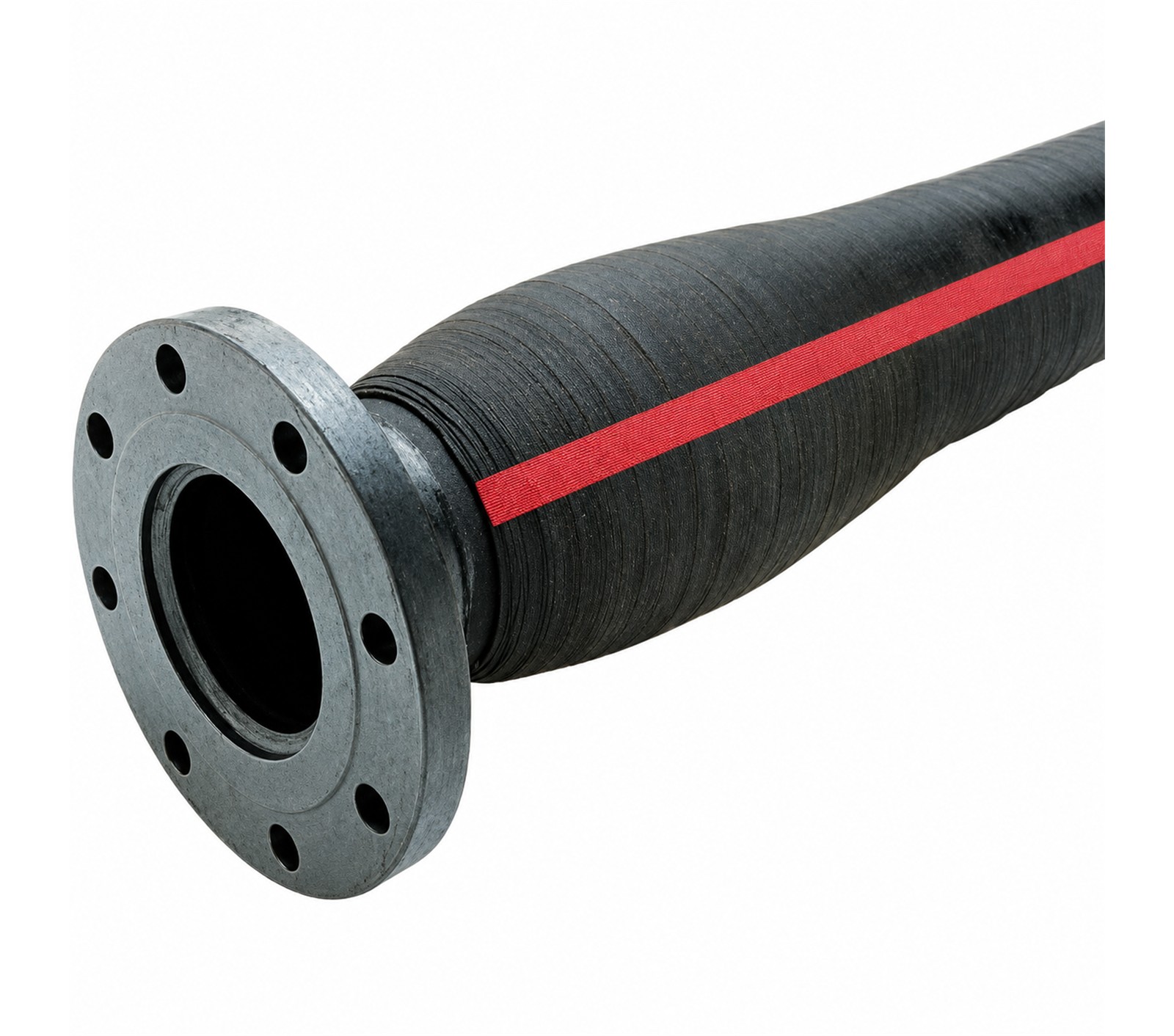



Dock oil hose is a heavy-duty petroleum-transfer construction for compatible liquids at marine and industrial loading points. The reference uses a nitrile tube, multiple synthetic tyre-cord plies, a wire helix and antistatic wires beneath a wrapped rubber cover. The dimensional schedule lists 300 psi working pressure.
Dock oil hose is a heavy-duty petroleum-transfer construction for compatible liquids at marine and industrial loading points. The reference uses a nitrile tube, multiple synthetic tyre-cord plies, a wire helix and antistatic wires beneath a wrapped rubber cover. The dimensional schedule lists 300 psi working pressure.
Potential transfer points include storage tanks, barges and vessels, subject to the fluid, assembly design and applicable operating procedure. Confirm flange standard, pressure rating, movement and continuity requirements for the complete hose assembly.
| ID (inch) | ID (mm) | OD (mm) | WP (bar) | WP (psi) | BP (bar) | BP (psi) | Length (m) | Length (ft) |
| 2 | 51 | 67 | 20 | 300 | 60 | 900 | 60 | 200 |
| 2-1/2 | 64 | 81 | 20 | 300 | 30 | 900 | 60 | 200 |
| 3 | 76 | 94 | 20 | 300 | 60 | 900 | 60 | 200 |
| 3-1/2 | 89 | 108 | 20 | 300 | 60 | 900 | 60 | 200 |
| 4 | 102 | 120 | 20 | 300 | 60 | 900 | 60 | 200 |
| 5 | 127 | 150 | 20 | 300 | 60 | 900 | 30 | 100 |
| 6 | 152 | 175 | 20 | 300 | 60 | 900 | 30 | 100 |
| 8 | 203 | 231 | 20 | 300 | 60 | 900 | 30 | 100 |
Source-data clarification: the 2-1/2-inch row lists burst pressure 30 bar / 900 psi; these values are inconsistent. Both are reproduced as published and must be resolved before selecting that size. Other rows list 60 bar / 900 psi. Nominal dimensions and length pairs are retained as provided.
The Celsius reference is −40°C to +100°C, equivalent to −40°F to +212°F; the source 180°F upper value does not match +100°C. The introduction mentions 50–100% aromatics while the construction and application sections limit the reference to up to 50%. Confirm the actual fluid and compound and do not assume 100% aromatic compatibility.
The source describes built-in flanges with one fixed and one swivel end. Confirm the flange dimensions, standard, material and assembly rating. No numerical vacuum rating, bend radius or marine certification is provided in this schedule.
Identify the petroleum product, aromatic content, additives and transfer temperature. State maximum pressure, suction conditions and possible pressure surges. Loading between fixed equipment and a moving vessel requires an application-specific assembly and support assessment.
Provide the flange standard, drilling pattern, nominal size and required fixed or swivel arrangement. Specify the finished assembly length, support positions and expected movement. Obtain the selected hose minimum bend radius and vacuum capability before approving routing.
Resolve the conflicting 2-1/2-inch burst-pressure entry and temperature reference with the supplier. Specify continuity, pressure-test and inspection documentation for the finished assembly. General descriptions of weather resistance and marine use do not establish a verified service life, certification or unlimited motion capability.
Specify material, ID and OD, working pressure, temperature, length, connections and quantity.



Send the conveyed material, pressure, temperature, required bore, installed length and fitting specification. Compare each related construction using its own dimensional and pressure schedule.


