
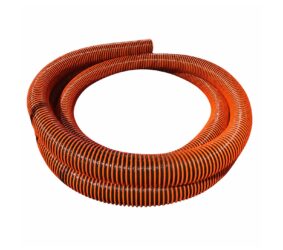


Flexible fuel-transfer hose for tank-truck gravity drop service and confirmed moderate-suction applications. Match the fuel blend, temperature and complete assembly specification.
Fuel drop hose is intended for tank-truck gravity unloading and compatible fuel-transfer duties. The source construction describes a special NBR tube, rigid PVC helix, embedded grounding wire and polyester reinforcement. Confirm the actual tube compound and reinforcement for the selected size.
The reference discusses gasoline, diesel, ethanol and biodiesel blends with aromatic content up to 60 percent. This is a compatibility claim requiring confirmation for the exact fuel composition, concentration, temperature and service duration; it does not establish universal suitability for every blend.
| Reference code | ID (inch) | ID (mm) | OD (mm) | WP (psi) | WP (bar) | Bend radius (inch) | Length (m) | Mass (kg/m) |
| NDH202 | 2 | 50.8 | 66 | 75 | 5 | 5 | 30 | 0.80 |
| NDH303 | 3 | 76 | 93 | 60 | 4 | 6 | 30 | 1.24 |
| NDH404 | 4 | 102 | 121 | 60 | 4 | 8 | 30 | 2.00 |
The listed 75 psi / 5 bar and 60 psi / 4 bar working-pressure pairs are rounded source values. The source gives no burst pressure or numerical vacuum rating. Confirm the governing pressure unit and assembly rating.
The reference temperature is -20°C to +65.5°C (-4°F to approximately +150°F). Gravity-drop or moderate-suction descriptions do not imply well-service injection capability or unrestricted full-vacuum service. Electrical resistance and continuity limits are not supplied.
Provide the fuel composition, unloading method, flow rate, operating pressure or suction, temperature, route and required couplings. Confirm the liner compatibility, helix protection, length and bend radius from the selected row.
Define the applicable grounding, bonding and electrical testing requirements for the complete assembly. The presence of a copper wire or a source claim of static dissipation alone is not a verified continuity result. Confirm coupling retention and inspect the hose and connections under the operating procedure before service.
Specify material, ID and OD, working pressure, temperature, length, connections and quantity.



Send the conveyed material, pressure, temperature, required bore, installed length and fitting specification. Compare each related construction using its own dimensional and pressure schedule.


